

As an Amazon Associate I earn from qualifying purchases.
Written by an AMGA-Certified Single Pitch Instructor & Experienced Outdoor Guide
Fact-checked against UIAA (International Climbing and Mountaineering Federation) and CE/EN Safety Standards
Rock climbing is an inherently dangerous activity where your life depends entirely on the integrity of your equipment and how you use it. Whether transitioning from top-roping at an indoor gym to leading on real rock, having a reliable gear checklist, known as the Rock Climbing Safety Equipment Checklist, ensures you stay secure while building confidence on the wall.
Rock Climbing Safety Equipment Checklist for Beginners
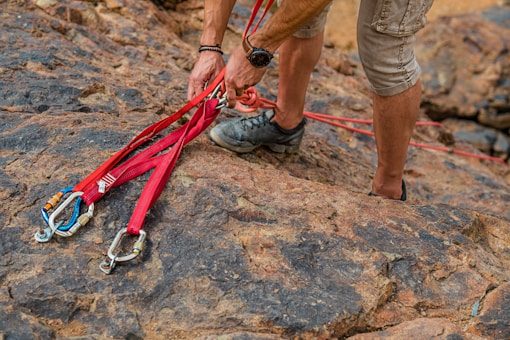
A comprehensive checklist should include items such as a climbing harness, helmet, carabiners, belay device, and climbing shoes. Additionally, it’s crucial to carry a crash pad if bouldering, along with appropriate clothing to protect against the elements. As you gain experience, consider adding more specialized gear like quickdraws and a rope. Regularly inspect your equipment for wear and tear to maintain safety and performance. Familiarizing yourself with proper usage techniques is essential for ensuring a safe climbing experience.
1. Core Essential Personal Safety Gear
These items form your personal fall-protection kit and must be individual investments fitted specifically to your body.
- Climbing Harness: Must fit snugly above your hip bones. Ensure it has rigid gear loops, padded leg loops, and clear tie-in points separate from the belay loop. Look for UIAA 105 or EN 12277 compliance.
- Climbing Helmet: Essential for outdoor climbing to protect against rockfall and inverted fall impacts. Modern expanded polystyrene (EPS) foam helmets with polycarbonate shells offer lightweight coverage meeting UIAA 106 standards.
- Locking Carabiners: Invest in at least two auto-locking or screwgate carabiners rated for at least $20\text{ kN}$ along the major axis (UIAA 121). These connect your belay device to your harness belay loop.
2. Belay & Rope Safety Hardware
Belaying requires hardware designed to dissipate kinetic energy through controlled friction.
- Assisted Braking Belay Devices: Devices like the Petzl GriGri or Black Diamond ATC Pilot feature mechanisms that assist in pinching the rope during a sudden fall, adding an extra layer of redundancy over standard tubular devices.
- Dynamic Climbing Rope: Never use static ropes for climbing where falls can occur. Dynamic ropes stretch ($30\% – 40\%$ dynamic elongation) to absorb impact force and reduce stress on anchor points and your body.
3. Essential Gear Checklist Comparison
| Equipment | Primary Purpose | Safety Standard | Recommended Replacement Horizon |
| Harness | Distributes fall impact to waist/thighs | UIAA 105 / EN 12277 | 3–5 years (Immediate if heavily worn) |
| Helmet | Protects against rockfall & impacts | UIAA 106 / EN 12492 | After 1 major impact or 5 years |
| Dynamic Rope | Absorbs kinetic energy during falls | UIAA 101 / EN 892 | 1–3 years active use (10 yrs shelf life) |
| Locking Carabiner | Connects safety points & belay devices | UIAA 121 / EN 362 | When rope-groove depth exceeds $1\text{ mm}$ |
Expert Safety Tips for Buying Equipment
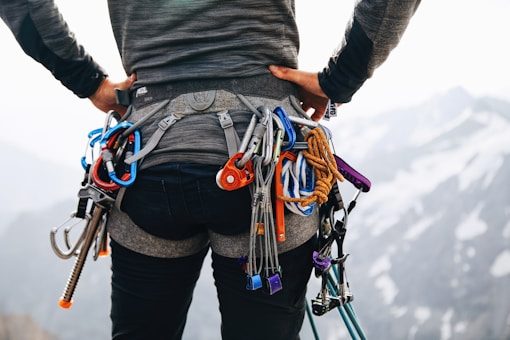
- Never Buy Second-Hand Soft Goods: Avoid buying used ropes, harnesses, or slings from online marketplaces. Micro-fractures in metal hardware and chemical/UV damage in nylon textiles cannot always be detected visually.
- Perform the Pre-Climb Partner Check: Before leaving the ground, physically and visually inspect your partner’s harness buckle (dead-ended and doubled back), tie-in knot (figure-eight re-threaded with a tail), belay device orientation, and locking carabiner engagement.
How to Inspect Climbing Ropes, Harnesses, and Slings Before Retirement
By an AMGA-Certified Single Pitch Instructor & Outdoor Gear Specialist
Compliant with UIAA (International Climbing and Mountaineering Federation) Gear Safety Guidelines
Climbing soft goods—your ropes, harnesses, slings, and personal anchor systems—are the flexible textile components that absorb fall energy. Unlike metal carabiners, nylon and Dyneema degrade through abrasion, UV exposure, and chemical contamination. Knowing how to systematically inspect soft goods before every outing is a critical safety discipline.
1. Inspecting Dynamic Climbing Ropes
A dynamic rope consists of two structural parts: the inner core (which handles $70\% – 80\%$ of the strength) and the outer sheath (which protects the core from abrasion).
Tactical Inspection Steps:
- Tactile Flaking Test: Pass the entire length of the rope slowly through your hands. Feel for flat spots, sudden thin areas, or squishy sections that indicate internal core damage (core shot).
- The Pinch Test: Bend the rope into a small loop ($U$-shape). If the rope pinches completely flat touching side-to-side with zero resistance, the internal core strands are compromised at that section.
- Visual Sheath Check: Look for heavy fuzzing, glazed or melted nylon from high-friction belays, and exposed white core strands.
When to Retire:
- Any visible white core strand showing through the sheath.
- A section fails the pinch test (chop the damaged end off and keep the healthy section if length permits).
- Direct contact with battery acid, bleach, or harsh chemical solvents.
2. Harness Inspection Protocols
Harnesses distribute fall force across your waist and thighs. Because tie-in points experience continuous rope friction, they wear down faster than the rest of the harness structure.
High-Wear Target Areas:
- Lower & Upper Tie-In Loops: Inspect for deep grooving or frayed nylon caused by rope friction during tie-ins and lowers. Many modern harnesses feature red indicator threads inside the tie-in points—if red threads are visible, retire immediately.
- Belay Loop: Check for fraying along the edges or uneven thinning. The belay loop must remain uniform in width.
- Buckle Webbing & Stitching: Inspect load-bearing bar-tacks (the dense, contrasting stitching holding the harness structure together). Ensure no threads are pulled, cut, or unraveling.
3. Webbing, Slings, and Runner Inspection
Slings and quickdraw dogbones are often constructed from Dyneema (UHMWPE) or Nylon. Dyneema has a lower melting point ($145^\circ\text{C}$ / $293^\circ\text{F}$) and degrades faster under direct friction.
- Stitching Bar-Tacks: Examine the sewn bar-tack on every runner. Discard if threads are broken or frayed.
- Edge Wear & Abrasion: Check edges for fuzzy cuts, fraying, or stiffened/melted spots from rock edges.
- Fading & Stiffness: Faded colors signify UV degradation. Stiff, board-like slings have lost elasticity and structural flexibility.
Soft Goods Inspection Matrix
| Gear Item | Primary Wear Indicators | Red Flags (Immediate Retirement) | Typical Shelf Life |
| Dynamic Rope | Sheath fuzz, stiff handling, core softness | Core shot, chemical contact, flattened pinch test | $1 – 3\text{ years}$ active use ($10\text{ yrs}$ max storage) |
| Harness | Frayed belay loop, worn tie-in points | Visible wear-indicator threads, damaged structural bar-tacks | $3 – 5\text{ years}$ active use |
| Dyneema / Nylon Slings | Faded color, fuzzy edges, stiff texture | Cut threads in bar-tack, melted/glazed sections | $2 – 5\text{ years}$ active use |

Storage & Care Rules to Maximize Lifespan
- Keep Away from Chemicals: Store soft goods away from gasoline, batteries, bleach, and cleaning solvents. Chemical exposure can destroy nylon strength without visible marks.
- Avoid UV & Heat: Never leave ropes or harnesses in direct sunlight or hot car trunks for extended periods. UV light breaks down synthetic polymer chains.
- Wash with Mild Soap: Wash dirty ropes in cool water using pure soap or specialized rope cleaner, then air-dry away from direct heat.
How to Inspect Metal Climbing Hardware for Wear and Micro-Cracks
By an AMGA-Certified Single Pitch Instructor & Technical Gear Specialist
Compliant with UIAA (International Climbing and Mountaineering Federation) and CE/EN Safety Standards
Metal climbing hardware—carabiners, belay devices, and spring-loaded camming devices (SLCDs)—is built from hot-forged aircraft-grade aluminum alloy ($7075\text{-T6}$ or $6061\text{-T6}$) or stainless steel. While hard goods do not degrade from UV light or age like textile soft goods, they suffer from friction wear, mechanical deformation, corrosion, and structural stress cracks.
1. Inspecting Carabiners and Quickdraw Hardware
Carabiners experience continuous friction from ropes and steel bolt hangers. Inspecting them requires checking both mechanical movement and surface integrity.
Key Inspection Steps:
- Rope Groove Depth: Check the basket where the rope runs. A shallow smooth groove is normal over time, but if the groove depth exceeds $1\text{ mm}$ or forms a sharp edge, retire the carabiner immediately. Sharp metal edges can slice a dynamic rope under fall tension.
- Gate Action & Alignment: Open the gate fully and let it snap shut. It must close quickly and align perfectly with the nose notch without sticking. Sticking gates are usually caused by grit or a weakened internal spring.
- Locking Mechanism Check: Screwgate barrels should thread smoothly end-to-end. Auto-locking barrels must twist, slide, and snap back into the locked position without manual assistance.
- Hanger Notch Wear: Inspect the top interior loop that clips into steel bolt hangers. Burrs or deep gouges in this section can damage slings or ropes during rope movement.
2. Inspecting Belay & Rappel Devices
Belay devices (tubular ATCs, figure-eights, and assisted-braking devices like Petzl GriGris) handle intense thermal dissipation and constant rope friction.
- Friction Wear & Knife Edges: Examine the internal rope channels. As aluminum wears down, the metal thins and creates razor-sharp “knife edges” along the top lip. If you can catch your fingernail on a sharp edge along the rope path, retire the device.
- Assisted-Braking Moving Parts: On mechanical devices (e.g., GriGri, Revo), inspect the steel camming plate, internal spring tension, and pivot rivets. Ensure the cam moves freely and snaps back under spring tension.
- Hinges & Cable Loops: Check the wire keeper cable for broken steel strands, excessive kinks, or loose plastic sheathing.
3. Inspecting Cams (Spring-Loaded Camming Devices)
Cams are complex mechanical assemblies with multiple moving parts, cables, and springs. They require the most thorough physical audit of any trad gear.
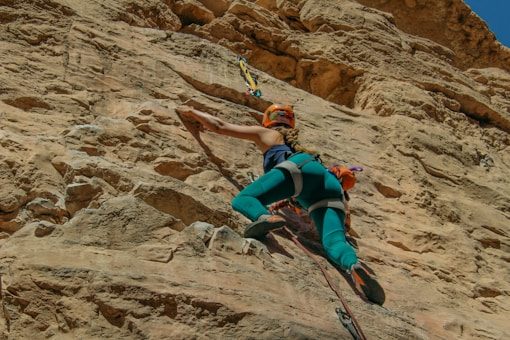
Inspection Checklist for SLCDs:
- Cam Lobe Teeth & Axles: Inspect individual aluminum teeth for rounded edges, severe pitting, or missing sections. Ensure the lobes rotate smoothly on the stainless steel axle without lateral wobble.
- Stem Cable & Swage Integrity: Check the flexible steel stem cable for frayed strands, severe permanent bends, or corrosion near the trigger swage.
- Trigger Wire Tension: Pull the trigger assembly to retract all four lobes simultaneously. The lobes must retract evenly and spring back symmetrically when released.
- Sling Condition: Remember that cams feature a sewn webbing sling attached to the thumb loop—apply textile soft-goods inspection rules to this sling.
4. The Micro-Crack Myth vs. Reality
A common belief among climbers is that dropping a carabiner onto rock from any height creates invisible “micro-cracks” that cause sudden catastrophic failure under body weight.
- What the Science Says: Metallurgical testing by gear manufacturers (such as Black Diamond and Petzl) confirms that modern aluminum alloys used in climbing gear are ductile. Dropping a carabiner on rock may cause cosmetic pitting or burrs, but it rarely creates internal micro-fractures unless subjected to extreme industrial impact forces.
- Visual Crack Detection: Actual structural cracks occur along high-stress points (the spine-to-basket curve or around the gate rivet pins). Use a magnifying glass under bright light. If a crack or hairline fissure is visible, the item must be retired immediately.
Metal Hardware Inspection Matrix
| Gear Item | Primary Wear Indicators | Immediate Retirement Criteria | Maintenance Action |
| Carabiners | Sticking gate, rope wear groove | Wear groove $>1\text{ mm}$, sharp edges, cracked body | Clean gate rivet with solvent, apply dry silicone lubricant |
| Belay Devices | Thinning rope channels, metal discoloration | Razor-sharp edges along rope path, cracked shell | Wash with warm water, clear dirt from pivot points |
| Camming Devices (Cams) | Frayed trigger wires, stiff lobe action | Broken stem cable strands, bent axles, uneven lobe retraction | Clean axles with warm water & brush, apply dry lube to springs |

Cleaning & Lubricating Metal Hardware
- Flush Out Grit: Submerge sticky carabiners or cams in warm, soapy water ($30^\circ\text{C} – 40^\circ\text{C}$). Work the gates or trigger wires repeatedly to flush out sand and salt residue.
- Apply Dry Lubricant: After air-drying, apply a drop of dry, wax-based or silicone-based lubricant (like WD-40 Specialist Dry Lube or Teflon-based lubes) to gate rivets, locking sleeves, and cam springs.
- Avoid Oil-Based Lubes: Never use heavy oil or WD-40 Multi-Use Spray, as they attract dust, sand, and grit, accelerating internal mechanical wear.
Final Verdict: Gear Inspection & Retirement Guidelines
Maintaining and inspecting rock climbing safety equipment is non-negotiable. While soft goods and hard goods wear down differently, adhering to a strict inspection protocol ensures maximum safety on the wall.
Core Retirement Thresholds at a Glance
- Soft Goods (Ropes, Harnesses, Slings):
- Retire Immediately: Any visible core shot (exposed inner strands on a rope), failed pinch test, visible wear-indicator threads on harness tie-in loops, severed bar-tack stitching, or chemical/acid contamination.
- Lifespan Horizon: 1–3 years under active use; 5 years max for light use; 10 years maximum shelf life (even if unused).
- Hard Goods (Carabiners, Belay Devices, Cams):
- Retire Immediately: Rope groove wear depth exceeding $1\text{ mm}$, sharp knife-edges along the rope track, cracked metal bodies, sticky/malfunctioning auto-locks, or frayed stem cables on cams.
- Lifespan Horizon: Indefinite if properly cleaned, lubricated, and maintained, provided no structural wear, razor edges, or mechanical failures occur.
Golden Rule of Climbing Safety
“When in doubt, throw it out.”
The financial cost of replacing a rope, harness, or carabiner is negligible compared to the catastrophic cost of an equipment failure on the wall. Never buy or sell second-hand soft goods, and conduct a thorough visual and tactile check before every single session.